
Utwórz bardzo prostą usługę Jersey REST i wyślij dane JSON z klienta Java
Opublikowany: 2013-11-29
Ostatnio muszę przekazywać dane JSON do usługi REST i nie miałem pod ręką żadnego prostego klienta. Stworzył jednak bardzo prosty program w języku Java, który odczytuje dane JSON z pliku i wysyła je do usługi REST.
Reprezentacyjny transfer stanu (REST) zyskał powszechną akceptację w sieci Web jako prostsza alternatywa dla usług sieci Web opartych na protokole SOAP i Web Services Description Language (WSDL). Kluczowym dowodem tej zmiany w projektowaniu interfejsów jest przyjęcie REST przez głównych dostawców usług Web 2.0 — w tym Yahoo, Google i Facebook — którzy wycofali lub przekazali interfejsy oparte na SOAP i WSDL na rzecz łatwiejszego w użyciu, model zorientowany na zasoby, aby wyeksponować swoje usługi. W tym artykule Alex Rodriguez przedstawia podstawowe zasady REST.
Zacznijmy kodować to:
- Utwórz usługę sieciową RESTFul
- Plik Java: CrunchifyRESTService.java
- plik web.xml
- Utwórz klienta usługi REST
- Plik CrunchifyRESTServiceClient.java
Inny musi przeczytać: Spring MVC Przykład/Tutorial: Hello World – Spring MVC 3.2.1
Krok 1
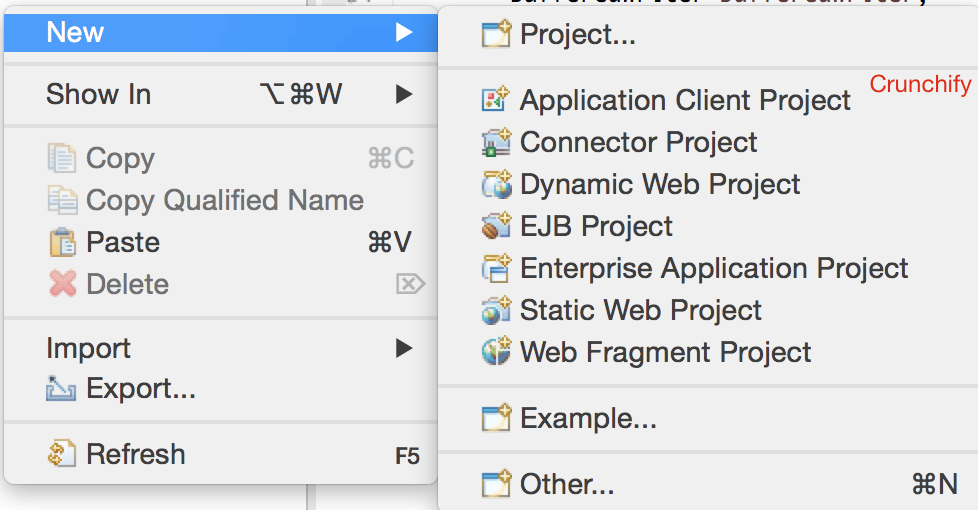
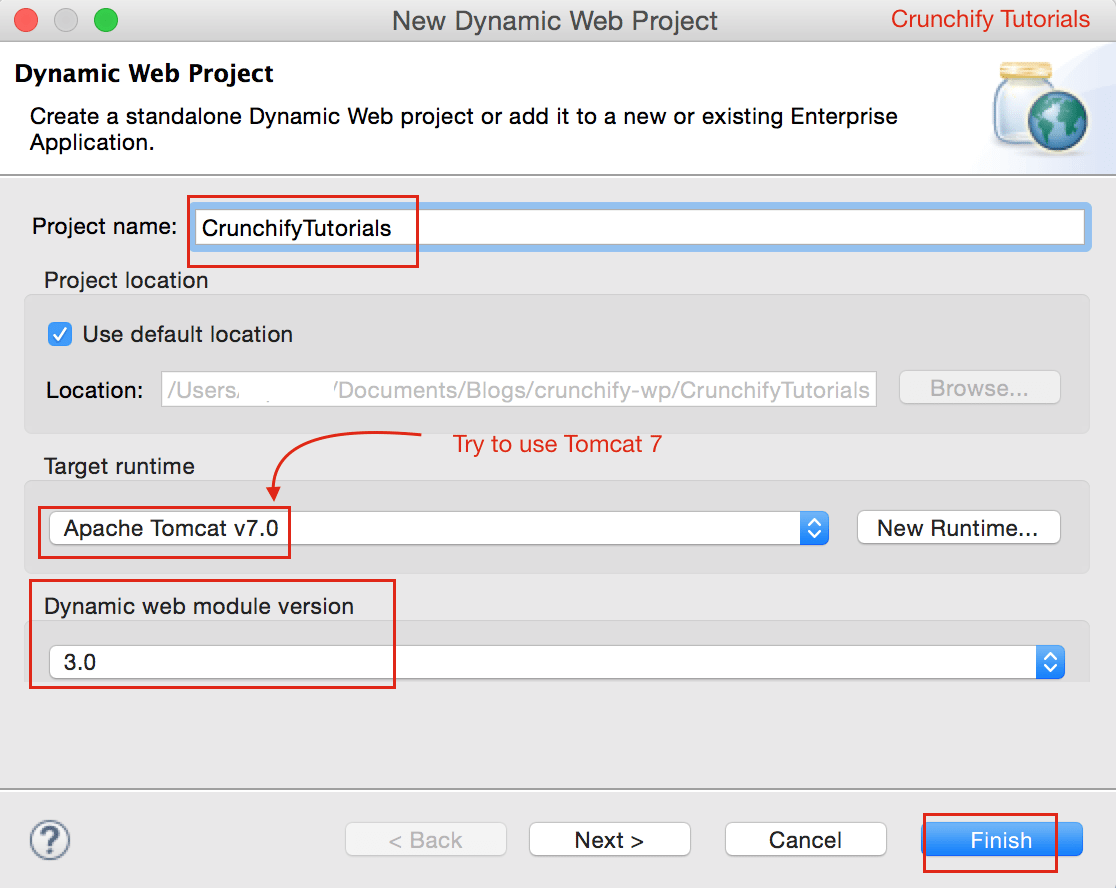
W Eclipse => File => New => Dynamic Web Project . Nazwij go jako „ CrunchifyTutorials ”. Poniższy samouczek działa również z Tomcat 8 .
Krok 2 Utwórz plik deskryptora wdrażania
Jeśli nie widzisz web.xml (deskryptor wdrażania) w obszarze WebContent\WEB-INF\ wykonaj następujące kroki.
Otwórz web.xml i zastąp zawartość poniższą zawartością:
|
1 2 3 4 5 6 7 8 9 10 11 12 13 14 15 16 17 18 19 20 21 22 23 24 25 |
<? xml version = "1.0" encoding = "UTF-8" ?> < web - app xmlns = "http://java.sun.com/xml/ns/javaee" xmlns : xsi = "http://www.w3.org/2001/XMLSchema-instance" xsi : schemaLocation = "http://java.sun.com/xml/ns/javaee http://java.sun.com/xml/ns/javaee/web-app_3_0.xsd" version = "3.0" > < display - name > CrunchifyRESTJerseyExample < / display - name > < welcome - file - list > < welcome - file > index . html < / welcome - file > < welcome - file > index . htm < / welcome - file > < welcome - file > index . jsp < / welcome - file > < welcome - file > default . html < / welcome - file > < welcome - file > default . htm < / welcome - file > < welcome - file > default . jsp < / welcome - file > < / welcome - file - list > < servlet > < servlet - name > Jersey Web Application < / servlet - name > < servlet - class > com . sun . jersey . spi . container . servlet . ServletContainer < / servlet - class > < load - on - startup > 1 < / load - on - startup > < / servlet > < servlet - mapping > < servlet - name > Jersey Web Application < / servlet - name > < url - pattern > / api /* < / url - pattern > < / servlet - mapping > < / web - app > |
Krok 3 Konwertuj projekt na projekt Maven
Postępuj zgodnie z tym samouczkiem: https://crunchify.com/how-to-convert-existing-java-project-to-maven-in-eclipse/. Oto mój plik pom.xml.
|
1 2 3 4 5 6 7 8 9 10 11 12 13 14 15 16 17 18 19 20 21 22 23 24 25 26 27 28 29 30 31 32 33 34 35 36 37 38 39 40 41 42 43 44 45 46 |
< project xmlns = "http://maven.apache.org/POM/4.0.0" xmlns : xsi = "http://www.w3.org/2001/XMLSchema-instance" xsi : schemaLocation = "http://maven.apache.org/POM/4.0.0 http://maven.apache.org/xsd/maven-4.0.0.xsd" > < modelVersion > 4.0.0 < / modelVersion > < groupId > CrunchifyTutorials < / groupId > < artifactId > CrunchifyTutorials < / artifactId > < version > 0.0.1 - SNAPSHOT < / version > < packaging > war < / packaging > < build > < sourceDirectory > src < / sourceDirectory > < plugins > < plugin > < artifactId > maven - compiler - plugin < / artifactId > < version > 3.1 < / version > < configuration > < source > 1.8 < / source > < target > 1.8 < / target > < / configuration > < / plugin > < plugin > < artifactId > maven - war - plugin < / artifactId > < version > 2.4 < / version > < configuration > < warSourceDirectory > WebContent < / warSourceDirectory > < failOnMissingWebXml > false < / failOnMissingWebXml > < / configuration > < / plugin > < / plugins > < / build > < dependencies > < dependency > < groupId > asm < / groupId > < artifactId > asm - all < / artifactId > < version > 3.3.1 < / version > < / dependency > < dependency > < groupId > com . sun . jersey < / groupId > < artifactId > jersey - bundle < / artifactId > < version > 1.14 < / version > < / dependency > < dependency > < groupId > org . json < / groupId > < artifactId > json < / artifactId > < version > 20090211 < / version > < / dependency > < / dependencies > < / project > |
Krok 4
Tworzenie usługi RESTFul: CrunchifyRESTService.java . Tutaj stworzymy dwie usługi:
-
/api/crunchifyService– wywołanie POST – użyjemy tego w naszym teście -
/api/verify– GET call – żeby upewnić się, że usługa została pomyślnie uruchomiona
|
1 2 3 4 5 6 7 8 9 10 11 12 13 14 15 16 17 18 19 20 21 22 23 24 25 26 27 28 29 30 31 32 33 34 35 36 37 38 39 40 41 42 43 44 45 46 47 48 49 50 51 52 53 |
package com . crunchify . tutorials ; /** * @author Crunchify.com * */ import java . io . BufferedReader ; import java . io . InputStream ; import java . io . InputStreamReader ; import javax . print . attribute . standard . Media ; import javax . ws . rs . Consumes ; import javax . ws . rs . GET ; import javax . ws . rs . POST ; import javax . ws . rs . Path ; import javax . ws . rs . Produces ; import javax . ws . rs . core . MediaType ; import javax . ws . rs . core . Response ; @Path ( "/" ) public class CrunchifyRESTService { @POST @Path ( "/crunchifyService" ) @Consumes ( MediaType . APPLICATION_JSON ) public Response crunchifyREST ( InputStream incomingData ) { StringBuilder crunchifyBuilder = new StringBuilder ( ) ; try { BufferedReader in = new BufferedReader ( new InputStreamReader ( incomingData ) ) ; String line = null ; while ( ( line = in . readLine ( ) ) ! = null ) { crunchifyBuilder . append ( line ) ; } } catch ( Exception e ) { System . out . println ( "Error Parsing: - " ) ; } System . out . println ( "Data Received: " + crunchifyBuilder . toString ( ) ) ; // return HTTP response 200 in case of success return Response . status ( 200 ) . entity ( crunchifyBuilder . toString ( ) ) . build ( ) ; } @GET @Path ( "/verify" ) @Produces ( MediaType . TEXT_PLAIN ) public Response verifyRESTService ( InputStream incomingData ) { String result = "CrunchifyRESTService Successfully started.." ; // return HTTP response 200 in case of success return Response . status ( 200 ) . entity ( result ) . build ( ) ; } } |

Krok-5
Wdróż projekt CrunchifyTutorials na Tomcat. Projekt internetowy powinien zostać wdrożony bez żadnych wyjątków.
- Kliknij prawym przyciskiem
Servers tabw Eclipse - Kliknij
Add and Remove...Projekt - Dodaj Project CrunchifyTutorials po prawej stronie
Configured:po stronie. - Kliknij
Publish - Kliknij
Start
Krok 6 Zweryfikuj usługę REST
Usługa odpoczynku powinna być dostępna pod tym adresem URL: http://127.0.0.1:8080/CrunchifyTutorials/api/verify
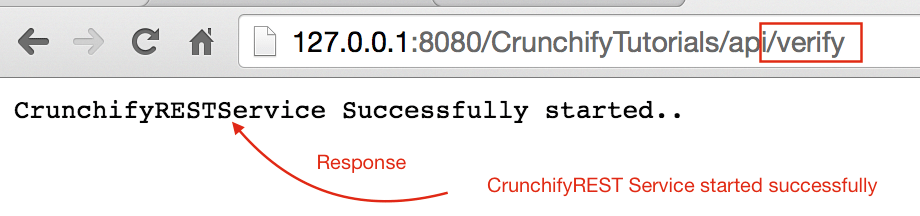
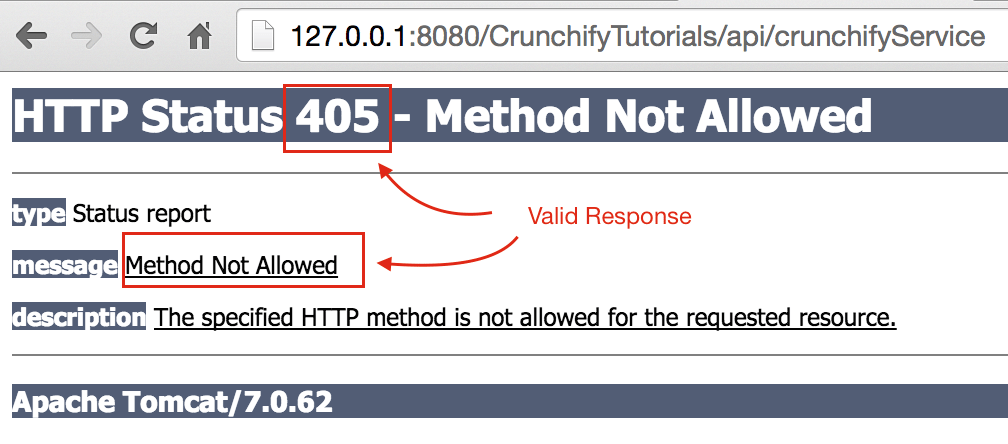
Jeśli spróbujesz uzyskać dostęp do http://127.0.0.1:8080/CrunchifyTutorials/api/crunchifyService, zobaczysz kod błędu 405 - Method not allowed – co jest prawidłową odpowiedzią. Jak widać, jest to wywołanie POST i powinno oczekiwać pewnych danych z żądaniem.
Przejdźmy dalej.
Krok-7
Skopiuj poniżej zawartość JSON i umieść ją w pliku C:\\CrunchifyJSON.txt w przypadku systemu Windows lub /Users/<nazwa użytkownika /Users/<username>/Documents/CrunchifyJSON.txt w przypadku Macbooka.
|
1 2 3 4 5 6 7 |
{ "tutorials" : { "id" : "Crunchify" , "topic" : "REST Service" , "description" : "This is REST Service Example by Crunchify." } } |
Krok 8
Utwórz klienta wywołania REST: CrunchifyRESTServiceClient.java.
Proszę change path to CrunchifyJSON.txt w poniższym programie.
|
1 2 3 4 5 6 7 8 9 10 11 12 13 14 15 16 17 18 19 20 21 22 23 24 25 26 27 28 29 30 31 32 33 34 35 36 37 38 39 40 41 42 43 44 45 46 47 48 49 50 51 52 53 54 55 56 57 58 59 60 61 62 63 64 |
package com . crunchify . tutorials ; import java . io . BufferedReader ; import java . io . FileInputStream ; import java . io . InputStream ; import java . io . InputStreamReader ; import java . io . OutputStreamWriter ; import java . net . URL ; import java . net . URLConnection ; import org . json . JSONObject ; /** * @author Crunchify.com * */ public class CrunchifyRESTServiceClient { public static void main ( String [ ] args ) { String string = "" ; try { // Step1: Let's 1st read file from fileSystem // Change CrunchifyJSON.txt path here InputStream crunchifyInputStream = new FileInputStream ( "/Users/<username>/Documents/CrunchifyJSON.txt" ) ; InputStreamReader crunchifyReader = new InputStreamReader ( crunchifyInputStream ) ; BufferedReader br = new BufferedReader ( crunchifyReader ) ; String line ; while ( ( line = br . readLine ( ) ) ! = null ) { string += line + "\n" ; } JSONObject jsonObject = new JSONObject ( string ) ; System . out . println ( jsonObject ) ; // Step2: Now pass JSON File Data to REST Service try { URL url = new URL ( "http://localhost:8080/CrunchifyTutorials/api/crunchifyService" ) ; URLConnection connection = url . openConnection ( ) ; connection . setDoOutput ( true ) ; connection . setRequestProperty ( "Content-Type" , "application/json" ) ; connection . setConnectTimeout ( 5000 ) ; connection . setReadTimeout ( 5000 ) ; OutputStreamWriter out = new OutputStreamWriter ( connection . getOutputStream ( ) ) ; out . write ( jsonObject . toString ( ) ) ; out . close ( ) ; BufferedReader in = new BufferedReader ( new InputStreamReader ( connection . getInputStream ( ) ) ) ; while ( in . readLine ( ) ! = null ) { } System . out . println ( "\nCrunchify REST Service Invoked Successfully.." ) ; in . close ( ) ; } catch ( Exception e ) { System . out . println ( "\nError while calling Crunchify REST Service" ) ; System . out . println ( e ) ; } br . close ( ) ; } catch ( Exception e ) { e . printStackTrace ( ) ; } } } |
Krok-9
Teraz uruchommy program klienta, klikając prawym przyciskiem myszy CrunchifyRESTServiceClient.java i powinieneś zobaczyć poniżej dwa wyjścia
1) w konsoli Tomcat

2) w lokalnej konsoli klienta
