
Tudo em um Tutorial Java Regex, Matcher Pattern e Expressões Regulares
Publicados: 2021-09-29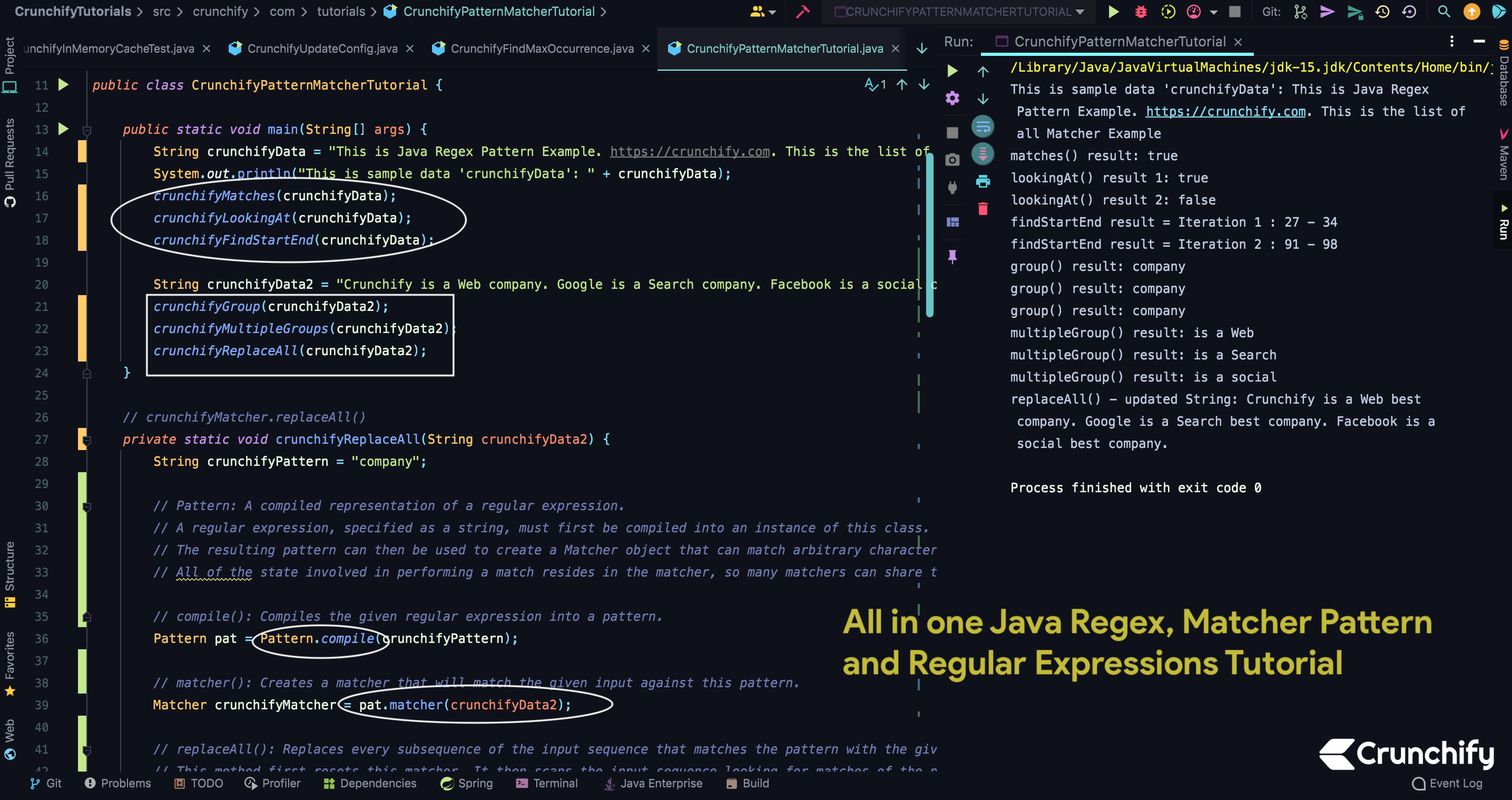
Neste tutorial, veremos a lista de APIs do Matcher ( java.util.regex.Matcher ). Algum tempo atrás eu escrevi um tutorial sobre Java Regex que cobre uma grande variedade de amostras.
Expressão Regular é um padrão de pesquisa para String. java.util.regex Classes para correspondência de sequências de caracteres com padrões especificados por expressões regulares em Java.
Este tutorial funciona melhor se você tiver alguma das perguntas abaixo:
- Java Regex – Tutorial
- Tutoriais de Expressões Regulares Java
- O que é expressão regular em Java?
- O que é padrão em Java?
- exemplo de correspondência de padrões java e caracteres especiais java regex
Vamos começar.
- Criar classe
CrunchifyPatternMatcherTutorial.java - Crie métodos diferentes para verificar abaixo as APIs do Matcher:
- partidas()
- olhando para()
- findStartEnd()
- grupo()
- váriosGrupos()
- substitua tudo()
- Imprima o resultado de cada API.
partidas()
matches() tenta corresponder a string inteira com o padrão. Ele retorna true se, e only if , toda a sequência da região corresponder ao padrão desse matcher.
olhando para()
A funcionalidade lookAt() é exatamente a mesma que matches(), exceto que tenta corresponder a sequência de entrada, começando no início da região, com o padrão. Ele retorna true se, e somente se, um prefixo da sequência de entrada corresponder ao padrão desse correspondente.
find(), start() e end()
find() tenta encontrar a próxima subsequência da sequência de entrada que corresponde ao padrão. start() tenta retornar o índice inicial da partida anterior e end() tenta retornar o índice final da partida anterior.
grupo()
group() retorna a subsequência de entrada correspondente à correspondência anterior. É como combinar entre start() e end().
váriosGrupos
multiplegroups podem ser representados por “(String) (String)”.
Exemplo: String crunchifyPattern = "(is) (.+?) (.+?) " ;
substitua tudo()
replaceAll() substitui cada subsequência da sequência de entrada que corresponde ao padrão com a string de substituição fornecida.
Aqui está um exemplo completo:
|
1 2 3 4 5 6 7 8 9 10 11 12 13 14 15 16 17 18 19 20 21 22 23 24 25 26 27 28 29 30 31 32 33 34 35 36 37 38 39 40 41 42 43 44 45 46 47 48 49 50 51 52 53 54 55 56 57 58 59 60 61 62 63 64 65 66 67 68 69 70 71 72 73 74 75 76 77 78 79 80 81 82 83 84 85 86 87 88 89 90 91 92 93 94 95 96 97 98 99 100 101 102 103 104 105 106 107 108 109 110 111 112 113 114 115 116 117 118 119 120 |
package crunchify . com . tutorials ; import java . util . regex . Matcher ; import java . util . regex . Pattern ; /** * @author Crunchify.com * All in one Java Regex, Matcher Pattern and Regular Expressions Tutorial. */ public class CrunchifyPatternMatcherTutorial { public static void main ( String [ ] args ) { String crunchifyData = "This is Java Regex Pattern Example. https://crunchify.com. This is the list of all Matcher Example" ; System . out . println ( "This is sample data 'crunchifyData': " + crunchifyData ) ; crunchifyMatches ( crunchifyData ) ; crunchifyLookingAt ( crunchifyData ) ; crunchifyFindStartEnd ( crunchifyData ) ; String crunchifyData2 = "Crunchify is a Web company. Google is a Search company. Facebook is a social company." ; crunchifyGroup ( crunchifyData2 ) ; crunchifyMultipleGroups ( crunchifyData2 ) ; crunchifyReplaceAll ( crunchifyData2 ) ; } // crunchifyMatcher.replaceAll() private static void crunchifyReplaceAll ( String crunchifyData2 ) { String crunchifyPattern = "company" ; // Pattern: A compiled representation of a regular expression. // A regular expression, specified as a string, must first be compiled into an instance of this class. // The resulting pattern can then be used to create a Matcher object that can match arbitrary character sequences against the regular expression. // All of the state involved in performing a match resides in the matcher, so many matchers can share the same pattern. // compile(): Compiles the given regular expression into a pattern. Pattern pat = Pattern . compile ( crunchifyPattern ) ; // matcher(): Creates a matcher that will match the given input against this pattern. Matcher crunchifyMatcher = pat . matcher ( crunchifyData2 ) ; // replaceAll(): Replaces every subsequence of the input sequence that matches the pattern with the given replacement string. // This method first resets this matcher. It then scans the input sequence looking for matches of the pattern. Characters that are not part of any match are appended directly to the result string; each match is replaced in the result by the replacement string. // The replacement string may contain references to captured subsequences as in the appendReplacement method. String updatedString = crunchifyMatcher . replaceAll ( "best company" ) ; System . out . println ( "replaceAll() - updated String: " + updatedString ) ; } private static void crunchifyMultipleGroups ( String crunchifyData2 ) { String crunchifyPattern = "(is) (.+?) (.+?) " ; Pattern pat = Pattern . compile ( crunchifyPattern ) ; Matcher crunchifyMatcher = pat . matcher ( crunchifyData2 ) ; // find(): Attempts to find the next subsequence of the input sequence that matches the pattern. while ( crunchifyMatcher . find ( ) ) { // group(): Returns the input subsequence matched by the previous match. // For a matcher m with input sequence s, the expressions m.group() and s.substring(m.start(), m. end()) are equivalent. // Note that some patterns, for example a*, match the empty string. // This method will return the empty string when the pattern successfully matches the empty string in the input. System . out . println ( "multipleGroup() result: " + crunchifyMatcher . group ( ) ) ; } } // crunchifyMatcher.group() private static void crunchifyGroup ( String crunchifyData2 ) { String crunchifyPattern = "company" ; Pattern pat = Pattern . compile ( crunchifyPattern ) ; Matcher crunchifyMatcher = pat . matcher ( crunchifyData2 ) ; while ( crunchifyMatcher . find ( ) ) { System . out . println ( "group() result: " + crunchifyMatcher . group ( ) ) ; } } // crunchifyMatcher.find() - start() - end() private static void crunchifyFindStartEnd ( String crunchifyData ) { String crunchifyPattern = "Example" ; Pattern pat = Pattern . compile ( crunchifyPattern ) ; Matcher crunchifyMatcher = pat . matcher ( crunchifyData ) ; int totalCount = 0 ; while ( crunchifyMatcher . find ( ) ) { totalCount ++ ; // start(): Returns the start index of the previous match. // end(): Returns the offset after the last character matched. System . out . println ( "findStartEnd result = Iteration " + totalCount + " : " + crunchifyMatcher . start ( ) + " - " + crunchifyMatcher . end ( ) ) ; } } // crunchifyMatcher.lookingAt() private static void crunchifyLookingAt ( String crunchifyData ) { String crunchifyPattern = "This is Java" ; Pattern pat = Pattern . compile ( crunchifyPattern ) ; Matcher crunchifyMatcher = pat . matcher ( crunchifyData ) ; // lookingAt(): Attempts to match the input sequence, starting at the beginning of the region, against the pattern. boolean isLookingAt = crunchifyMatcher . lookingAt ( ) ; System . out . println ( "lookingAt() result 1: " + isLookingAt ) ; crunchifyPattern = " is Java" ; pat = Pattern . compile ( crunchifyPattern ) ; crunchifyMatcher = pat . matcher ( crunchifyData ) ; isLookingAt = crunchifyMatcher . lookingAt ( ) ; System . out . println ( "lookingAt() result 2: " + isLookingAt ) ; } // crunchifyMatcher.matches() public static void crunchifyMatches ( String crunchifyData ) { String crunchifyPattern = ".*https://.*" ; Pattern pat = Pattern . compile ( crunchifyPattern ) ; Matcher crunchifyMatcher = pat . matcher ( crunchifyData ) ; boolean isMatched = crunchifyMatcher . matches ( ) ; System . out . println ( "matches() result: " + isMatched ) ; } } |
Resultado do Console do Eclipse:
|
1 2 3 4 5 6 7 8 9 10 11 12 13 |
This is sample data 'crunchifyData' : This is Java Regex Pattern Example . https : //crunchify.com. This is the list of all Matcher Example matches ( ) result : true lookingAt ( ) result 1 : true lookingAt ( ) result 2 : false findStartEnd result = Iteration 1 : 27 - 34 findStartEnd result = Iteration 2 : 90 - 97 group ( ) result : company group ( ) result : company group ( ) result : company multipleGroup ( ) result : is a Web multipleGroup ( ) result : is a Search multipleGroup ( ) result : is a social replaceAll ( ) - updated String : Crunchify is a Web best company . Google is a Search best company . Facebook is a social best company . |
Deixe-me saber se você tiver alguma dúvida sobre a execução do programa acima.
