
O implementare simplă a listelor legate individual în Java
Publicat: 2013-11-27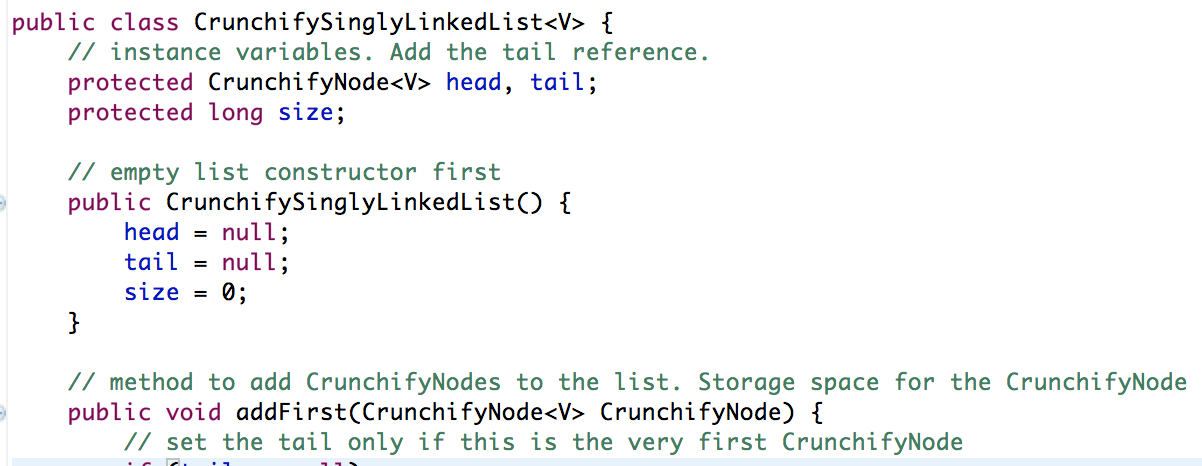
În acest tutorial voi arăta implementarea simplă a listei cu legături individuale în Java.
O listă legată este o serie de noduri din memorie astfel încât:
- Există un nod de pornire.
- Fiecare nod conține un pointer care indică nodul următor sau copil.
- Dacă un nod nu are un nod copil, atunci pointerul său este setat la NULL.
- Fiecare nod conține date, poate multe.
- Lista legată are și funcții care gestionează lista efectuând adăugiri, ștergeri, modificarea datelor unui nod, returnarea numărului de noduri etc., etc.
Dacă aveți oricare dintre întrebările de mai jos, vă aflați la postarea corectă de blog:
- Cum să ștergeți un nod dat din Lista legată
- Ștergeți un nod din mijlocul unei liste conectate individual
- LISTA LEGATĂ SINGUR :: ELIMINAREA (ȘTERGEREA)
- Eliminarea nodurilor dintr-o listă legată individual
O listă legată este utilizată în aceleași scopuri ca și o matrice. Cu toate acestea, lista legată are câteva avantaje: o matrice este de dimensiune fixă (cu excepția cazului în care este alocată dinamic), o listă legată poate crește prin preluarea de memorie nouă din heap, după cum este necesar. Dacă stocați o listă într-o matrice și apoi ștergeți un element din mijloc, atunci trebuie să mutați o mulțime de articole în jos unul pentru a reduce decalajul. Dar într-o listă legată, pur și simplu redirecționați pointerii în jurul nodului de șters, apoi îl ștergeți.
Iată o implementare simplă a listei Singly Linked:
|
1 2 3 4 5 6 7 8 9 10 11 12 13 14 15 16 17 18 19 20 21 22 23 24 25 26 27 28 29 30 31 32 33 34 35 36 37 38 39 |
package com . crunchify . tutorials ; /** * @author Crunchify.com * */ public class CrunchifyNode <V> { // instance variables private V element ; private CrunchifyNode <V> next ; // constructor first public CrunchifyNode ( ) { this ( null , null ) ; } public CrunchifyNode ( V element , CrunchifyNode <V> next ) { this . element = element ; this . next = next ; } public V getElement ( ) { return element ; } public CrunchifyNode <V> getNext ( ) { return next ; } public void setElement ( V element ) { this . element = element ; } public void setNext ( CrunchifyNode <V> next ) { this . next = next ; } } |
|
1 2 3 4 5 6 7 8 9 10 11 12 13 14 15 16 17 18 19 20 21 22 23 24 25 26 27 28 29 30 31 32 33 34 35 36 37 38 39 40 41 42 43 44 45 46 47 48 49 50 51 52 53 54 55 56 57 58 59 60 61 62 63 64 65 66 67 68 69 70 71 72 73 74 75 76 77 78 79 80 81 82 83 84 85 86 87 88 89 90 91 92 93 94 95 96 97 98 99 100 101 102 103 104 105 106 107 108 109 110 111 112 113 114 115 116 117 118 119 120 121 122 123 124 125 126 127 128 129 130 131 132 133 134 135 136 137 138 139 140 141 142 143 144 145 |
package com . crunchify . tutorials ; /** * @author Crunchify.com * */ public class CrunchifySinglyLinkedList <V> { // Instance Variables. Add the tail reference. protected CrunchifyNode <V> head , tail ; protected long size ; // Empty list constructor first public CrunchifySinglyLinkedList ( ) { head = null ; tail = null ; size = 0 ; } // Method to add CrunchifyNodes to the list. Storage space for the CrunchifyNode is already allocated in the calling method public void addFirst ( CrunchifyNode <V> CrunchifyNode ) { // Set the tail only if this is the very first CrunchifyNode if ( tail == null ) tail = CrunchifyNode ; CrunchifyNode . setNext ( head ) ; // Make next of the new CrunchifyNode refer to the head head = CrunchifyNode ; // Give head a new value // change the size size ++ ; } // Add new CrunchifyNode after current CrunchifyNode, checking to see if we are at the tail public void addAfter ( CrunchifyNode <V> currentCrunchifyNode , CrunchifyNode <V> newCrunchifyNode ) { if ( currentCrunchifyNode == tail ) tail = newCrunchifyNode ; newCrunchifyNode . setNext ( currentCrunchifyNode . getNext ( ) ) ; currentCrunchifyNode . setNext ( newCrunchifyNode ) ; // change the size size ++ ; } // Add new CrunchifyNode after the tail CrunchifyNode. public void addLast ( CrunchifyNode <V> CrunchifyNode ) { CrunchifyNode . setNext ( null ) ; tail . setNext ( CrunchifyNode ) ; tail = CrunchifyNode ; size ++ ; } // Methods to remove CrunchifyNodes from the list. (Unfortunately, with a single linked list. there is no way to remove last. Need a previous reference to do that. public CrunchifyNode <V> removeFirst ( ) { if ( head == null ) System . err . println ( "Error: Attempt to remove from an empty list" ) ; // save the one to return CrunchifyNode <V> temp = head ; // do reference manipulation head = head . getNext ( ) ; temp . setNext ( null ) ; size -- ; return temp ; } // Remove the CrunchifyNode at the end of the list. tail refers to this CrunchifyNode, but since the list is single linked, there is no way to refer to the CrunchifyNode before the tail CrunchifyNode. Need to traverse the list. public CrunchifyNode <V> removeLast ( ) { // Declare local variables/objects CrunchifyNode <V> CrunchifyNodeBefore ; CrunchifyNode <V> CrunchifyNodeToRemove ; // Make sure we have something to remove if ( size == 0 ) System . err . println ( "Error: Attempt to remove fron an empty list" ) ; // Traverse through the list, getting a reference to the CrunchifyNode before the trailer. Since there is no previous reference. CrunchifyNodeBefore = getFirst ( ) ; for ( int count = 0 ; count < size - 2 ; count ++ ) CrunchifyNodeBefore = CrunchifyNodeBefore . getNext ( ) ; // Save the last CrunchifyNode CrunchifyNodeToRemove = tail ; // Let's do the pointer manipulation CrunchifyNodeBefore . setNext ( null ) ; tail = CrunchifyNodeBefore ; size -- ; return CrunchifyNodeToRemove ; } // Remove a known CrunchifyNode from the list. No need to search or return a value. This method makes use of a 'before' reference in order to allow list manipulation. public void remove ( CrunchifyNode <V> CrunchifyNodeToRemove ) { // Declare local variables/references CrunchifyNode <V> CrunchifyNodeBefore , currentCrunchifyNode ; // Make sure we have something to remove if ( size == 0 ) System . err . println ( "Error: Attempt to remove fron an empty list" ) ; // Starting at the beginning check for removal currentCrunchifyNode = getFirst ( ) ; if ( currentCrunchifyNode == CrunchifyNodeToRemove ) removeFirst ( ) ; currentCrunchifyNode = getLast ( ) ; if ( currentCrunchifyNode == CrunchifyNodeToRemove ) removeLast ( ) ; // We've already check two CrunchifyNodes, check the rest if ( size - 2 > 0 ) { CrunchifyNodeBefore = getFirst ( ) ; currentCrunchifyNode = getFirst ( ) . getNext ( ) ; for ( int count = 0 ; count < size - 2 ; count ++ ) { if ( currentCrunchifyNode == CrunchifyNodeToRemove ) { // remove current CrunchifyNode CrunchifyNodeBefore . setNext ( currentCrunchifyNode . getNext ( ) ) ; size -- ; break ; } // Change references CrunchifyNodeBefore = currentCrunchifyNode ; currentCrunchifyNode = currentCrunchifyNode . getNext ( ) ; } } } // The gets to return the head and/or tail CrunchifyNodes and size of the list public CrunchifyNode <V> getFirst ( ) { return head ; } public CrunchifyNode <V> getLast ( ) { return tail ; } public long getSize ( ) { return size ; } } |

Simțiți-vă liber să furnizați comentariul dvs. dacă găsiți vreo eroare sau altă condiție care nu este tratată corect :). Feedback-ul dumneavoastră este foarte apreciat.